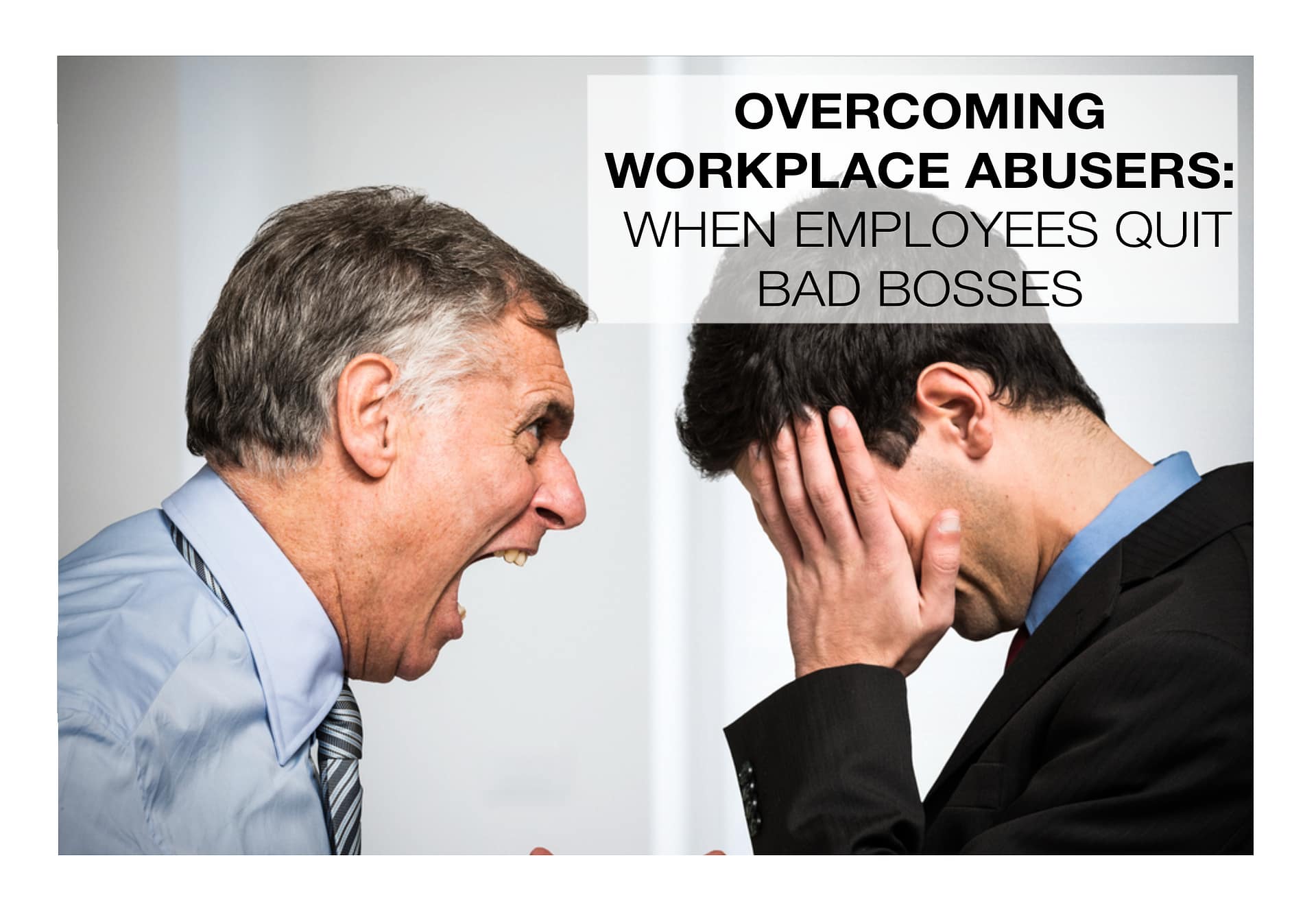
It’s been said employees don’t quit bad companies, they leave bad managers. But what makes a manager become abusive in the workplace?
Our character traits are usually formed during our childhood. Those who are emotionally or mentally manipulated by their peers or adults often grow up seeking an outlet to exert their control over others. If they are larger than their peers, it could be through threats of physical harm upon others.
As adults, some resort to workplace bullying. They don’t have to be bosses; many people can share stories of coworkers who boss them around, even when lacking the authority to carry out such acts.
But what about when they rise in the ranks and become the managers of others? Emboldened with such authority, they may wantonly exert their will upon others. They may make demeaning demands or assign tasks or projects beneath those they oversee. Maybe they’ll threaten poor performance reviews or stifle others’ growth at the company.
To be clear, this article is not exploring threats or actual incidents of physical or sexual abuse. If such criminal behaviour has been perpetrated upon you or someone you know, immediately document it, report it to human resources and to the proper authorities.
Last year, we wrote about the harm and hardships abuse in families and the workplace. In it, we noted how the abused are the victims, and how “blame lies solely with the abuser, who grows relentless in pursuit of the ends he seeks. This can last for years, even decades. Imagine suffering such a relentless, ceaseless onslaught day after day, year after year. Subtle as it may be, it’s still chipping away at one’s resistance.”
Surviving abuse is a two-way street. Abusers must recognise that they are abusers and come to terms with the harm they’re committing upon others. True healing starts with acknowledgment and follows with a sincere apology, which should help them in their path to recovery.
The “abused” also needs to realise, in most cases, “it’s not your fault.” In the movie Good Will Hunting, a pivotal scene was a therapy session between Will Hunting (played by Matt Damon) and Dr. Sean Maguire (played by Robin Williams). Sean repeats the phrase to help Will process the trauma of his past abuse and release the guilt and shame he’s internalized all his life. Will Hunting soon realises this truth and hugs Dr. Maguire in tears.
Abusive bosses in the workplace can be harmful, even disastrous to corporate culture, employee performance and financial returns. A recent incident shared with me bears repeating. A vice president in a workplace was verbally abusive to her subordinates. One 20-something early in her professional career decided to suck it up and play to her manager’s emotions. She has since found balance with her boss.
When the abuse became too much to bear for a coworker a few years older and further along in her professional life, she said “No!” She gave notice – and in her exit interview explicitly noted her manager’s role in her decision.
Based on that and other conversations, human resources has opened an investigation into the VP’s behaviour. As I write this story, the investigation is still unfolding.
The problem often is, the abused believe their abuse is happening in a vacuum. They’re alone and to raise their concerns creates a “me against them” situation. “Who are they going to believe, me or the executive?” Or worse still, that such abuse is some acceptable rite of passage. It is not.
Everyone’s situation is different. Yet awareness of abusive conditions in the workplace, the classroom, the family or anyplace where individuals may have authority over others can encourage people to speak up and confront the abuser.
Executive leadership, school administrators, peers, and especially parents must always be on high alert for signs of abuse. They might not be obvious, but we must learn to spot them. Has your outgoing child – or friends or coworkers – become an introvert? Have they turned away from their once-close friendships? Would they rather spend weekends alone at home, than out with friends or coworkers? This might not be “antisocial” behaviour. This may be their coping mechanism to help them deal with the abuse, as they are unaware of how to respond.
Be ready to have the hard conversations. Parents need to be comfortable talking with their children about what the parent is witnessing and what they believe may be happening to their child. This doesn’t start when the child is an adolescent. It must start much younger, in order to encourage the child to open up, from an early age. That makes honest engagement a natural encounter. This way, any embarrassment, humiliation or emasculation is replaced with understanding and support. This also is true for coworkers, managers and others in a position to see and address abuse.
Keep in mind the following when faced with your child’s, peer’s, coworker’s or subordinate’s changing behaviour…
- Look for the signs. What has changed? What’s different today that wasn’t the same before?
- Don’t deflect. Accept that anyone – even the strongest among us – can be victims of abuse.
- Open the door. Welcome those you support to speak freely and confidentially. Even if they turn you down, trust me, the seed you plant is sprouting in their minds.
- Make sure they understand that you are on their side and will support any decision they choose.
Schools are “mandated reporters” that must report on incidents of suspected abuse. The workplace and home are not. For this reason, we must question anything that seems out of the ordinary. Take “See something, say something” to heart. If you truly feel a family situation requires escalation, contact Child Protective Services or the Crisis Hotline.
Again, this article is not exploring threats or actual incidents of physical or sexual abuse. If such criminal behaviour has been perpetrated upon you or someone you know, immediately document it, report it to human resources, or the proper authorities.
We are surrounded by cases of emotional abuse in the workplace, school or the homes of even our closest friends. If you believe you’re witnessing such abuse and don’t know how or whether to intervene, give me a call. I can help point you in the right direction to support those who need an advocate in a tough situation.
Leave A Comment